Free FBA tool
FBA Pallet Calculator
Your numbers
Master carton
Amazon states its pallet rules in inches and pounds, so imperial is the default. Sourcing from a supplier spec in cm / kg? Switch units above.
Pallets needed
5 pallets
30 cartons per pallet, built 66 in tall and 800 lb. The build is height-bound, comfortably under the 1,500 lb weight cap. Your 125 cartons make 5 pallets, 4 full plus 5 cartons on the last.
Cartons per layer
6
14 in side along the 48 in side, 18 in along the 40 in side
Layers
5
stacked flat
Cartons per pallet
30
after height and weight caps
Total cartons
125
from your units
Pallet height
66 in
72 in max incl pallet
Pallet weight
800 lb
1,500 lb max
Each block is one carton layer on the 40 x 48 deck, stacked flat toward the 72 in cap.
Inventory Hero
From pallet build to a shipment plan
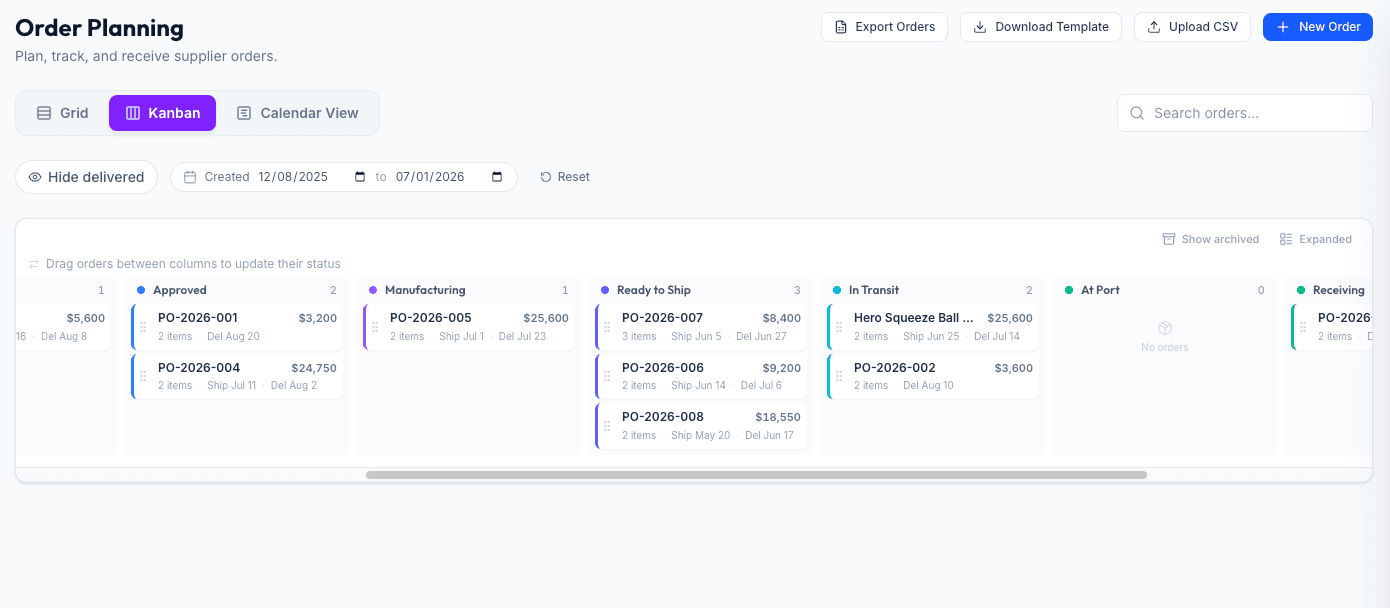
Cartons and pallets are the last step of a shipment, not the first. Inventory Hero plans the whole flow: how many units to send based on your velocity and lead times, then tracks the purchase order from the factory through freight to the FC, so the pallet you build matches the quantity you actually need.
- Send quantities tied to your reorder points, not guesses
- Every shipment tracked from manufacturing to receiving
- Landed cost per unit kept current as freight and rates move
No credit card required.
How the math works
- Cartons per layer = best of floor(48 / L) x floor(40 / W) and floor(48 / W) x floor(40 / L)
- Layers = floor((72 - 6) / carton height)
- Weight cap = floor((1,500 - 50) / carton weight)
- Cartons per pallet = the smaller of layers x per-layer and the weight cap
- Pallets = round up (total cartons / cartons per pallet)
The rules these use are Amazon's for LTL and FTL FBA deliveries: a 40 x 48 inch GMA wood pallet with 4-way entry, a maximum 72 inch single-pallet height including the pallet (100 inches when double-stacked in the trailer), a maximum 1,500 lb per pallet including the pallet, and at most 1 inch of carton overhang. This calculator packs to the deck with no overhang and subtracts a roughly 6 inch, 50 lb pallet deck before it counts layers and weight.
Worked example
Your master carton is 18 x 14 x 12 inches and weighs 25 lb, packing 24 units. You are sending 3,000 units to FBA.
- Cartons: 3,000 / 24 = 125 cartons
- Per layer: 6 cartons, turned so the 14 in side runs along the 48 in side and the 18 in side along the 40 in side (that beats the 4 you get the other way)
- Layers: 5, since (72 - 6) / 12 = 5.5 rounds down to 5
- Per pallet: 6 x 5 = 30 cartons, and at 25 lb each that is 800 lb, well under the 1,500 lb cap, so this build is height-bound
- Built pallet: 66 in tall (6 in deck plus 5 layers of 12 in) and 800 lb
- Pallets: 125 / 30 rounds up to 5 pallets, with 5 cartons on the last one
Five pallets is a typical LTL load, nowhere near a full truck. When you book it, your LTL quote also depends on the freight class (NMFC) and density, and the carrier or broker prepares the bill of lading, so ask your broker for both; this calculator covers the physical build Amazon will accept at the dock.
This is the same shipment as the freight and container calculator example, so you can see the identical cartons as ocean volume there and as a pallet build here. For the shipment volume in cubic meters on its own, use the CBM calculator, and to decide how many units to send in the first place, the FBA restock calculator.
Dock rules change. The 40 x 48 pallet, 72 in height, 1,500 lb weight, and 1 in overhang limits here follow Amazon's published LTL, FTL, and FCL delivery requirements, but before you book freight, confirm the live numbers on Amazon Seller Central's pallet and delivery requirements page.
Key terms
- GMA pallet
- The 40 x 48 inch wood pallet the Grocery Manufacturers Association standardized, with 4-way forklift entry. It is the default pallet Amazon requires for FBA LTL and FTL deliveries, which is why the layer math is built around the 48 in and 40 in deck sides.
- LTL vs FTL
- Less-than-truckload (LTL) ships your pallets alongside other shippers' freight and bills by space and weight used; full-truckload (FTL) books the whole trailer. Most FBA restocks go LTL, so the number of pallets you build directly drives the freight quote.
- Double-stacking
- Placing one pallet on top of another in the trailer, allowed up to a combined 100 inches. It is a trailer-loading efficiency, not a taller single pallet, so it does not change how tall you build one pallet (still 72 inches), only how many fit in the truck.
Frequently asked questions
What pallets does Amazon require for FBA?
Amazon requires a standard 40 x 48 inch GMA wood pallet with 4-way entry, Grade B or higher, for LTL and FTL deliveries into a fulfillment center. Cartons are stacked on the deck, stretch-wrapped, and labeled. This calculator fits your master cartons to that exact 40 x 48 footprint with no overhang, which is the safe way to read the rule.
How tall can an FBA pallet be?
A single FBA pallet can be up to 72 inches tall including the pallet itself, so with a roughly 6 inch deck you get about 66 inches of usable cargo height. Amazon allows pallets to be double-stacked up to 100 inches total in the trailer, but that is a trailer-loading rule, not permission to build one taller pallet, so the per-pallet math still stops at 72 inches.
How much weight can an FBA pallet hold?
The cap is 1,500 pounds per pallet, including the weight of the pallet itself (a GMA wood deck is roughly 50 pounds). For dense products such as liquids or hardware you can hit 1,500 pounds long before you reach the 72 inch height, so this calculator caps cartons per pallet on whichever limit binds first and flags when weight is the one holding you back.
Can cartons overhang the edge of the pallet?
Amazon allows at most 1 inch of overhang on any side, but overhang crushes cartons in transit and risks rejection at the dock, so the reliable approach is to pack within the 40 x 48 footprint with no overhang. This calculator packs to the deck, so the cartons-per-layer count it gives you is one you can actually build and ship without a compliance problem.
How many pallets fit in a truck?
As general trucking guidance, a 53 foot dry van holds about 26 standard 40 x 48 pallet positions on the floor, and roughly double that if every pallet is safely double-stackable to the 100 inch trailer height. Your real count depends on pallet weight, product fragility, and whether the load can be stacked, so treat 26 floor positions as a planning number and confirm with your carrier. Most FBA restocks are nowhere near that: a handful of pallets ships LTL, and a full truck only starts to make sense as you approach 20 or more.
Do I even need pallets to ship to FBA?
Not always. Small shipments usually go in as small parcel delivery (individual boxes on a carrier like UPS), and larger ones go LTL or FTL on pallets. A common rule of thumb is that once a shipment is heavy or bulky, roughly 150 pounds or more, or more than a handful of boxes, palletized LTL becomes cheaper and safer than small parcel. Check the current thresholds in your shipping workflow, since Amazon sets them per shipment.
Inventory Hero
Send the right quantity, then build the pallets
Inventory Hero tells you how many units to send to FBA from your real sales velocity and lead times, tracks each shipment from the factory to the fulfillment center, and keeps your landed cost per unit current, so the pallets you build always match the order you actually need.
30-day free trialNo credit card required.
Embed this calculator
Free to use on your own site or blog. Paste this snippet where you want the calculator to appear. It keeps a small credit link back to Inventory Hero.
<iframe src="https://www.inventoryhero.ai/embed/fba-pallet-calculator?utm_source=embed&utm_medium=iframe" title="FBA Pallet Calculator by Inventory Hero" width="100%" height="720" style="border:1px solid #e5e5e5;border-radius:16px;max-width:680px" loading="lazy"></iframe>
<p style="font:13px/1.5 system-ui,sans-serif;text-align:center;margin:8px 0 0"><a href="https://www.inventoryhero.ai/tools/fba-pallet-calculator">FBA Pallet Calculator</a> by Inventory Hero</p>See all our free Amazon FBA calculators.