Free FBA tool
Freight & Container Load Calculator
Your numbers
Master carton
Sourcing overseas? Your supplier's spec sheet is usually in cm / kg, so switch units above.
Shipment volume
6.19 CBM
125 cartons, 218.8 cu ft. Under about 15 CBM, so LCL (less-than-container-load) is usually cheaper than a full container.
Cartons
125
1.8 cu ft each
Total weight
1,417.5 kg
3,125 lb gross
Freight / unit
$1.80
From your quote
Freight / carton
$43.20
From your quote
This shipment is small enough for LCL; the bars show how little of each full container it would fill. Fill is the share of each container's internal volume. Real-world loading reaches about 85% of that (less for cartons that don't stack neatly on pallets), so plan headroom.
Inventory Hero
From freight quote to true landed cost
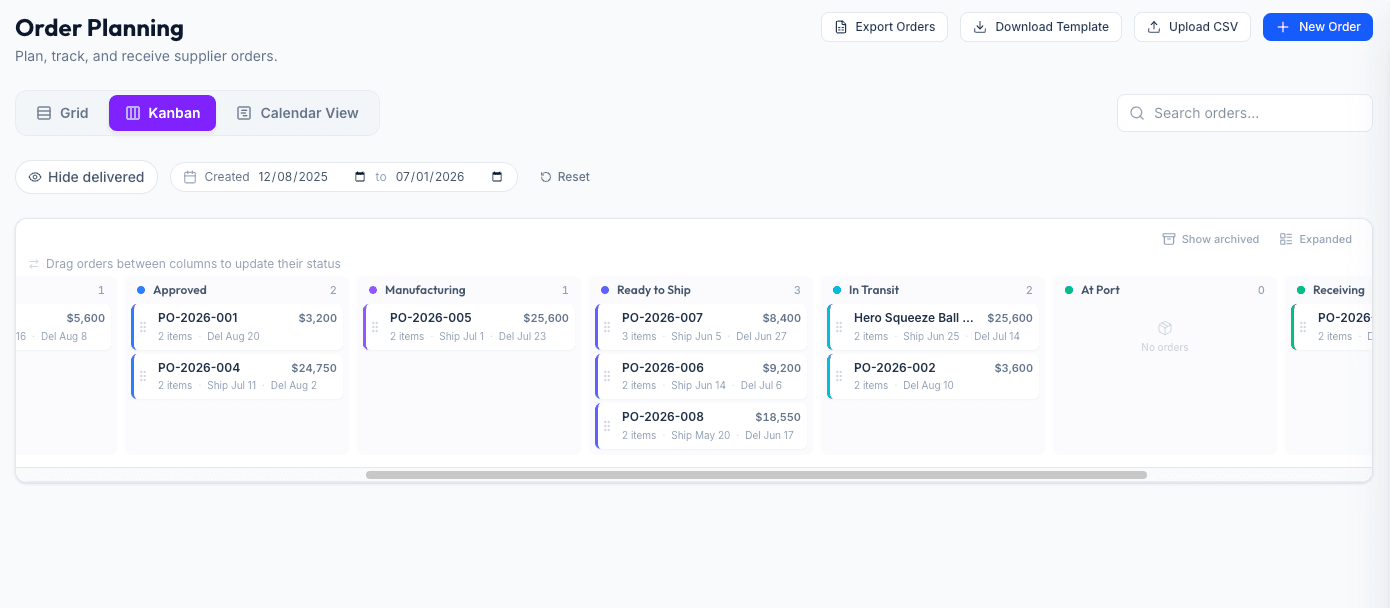
Volume and weight are half the story. Inventory Hero rolls your freight into a real per-unit landed cost alongside duty and prep, ties it to your reorder timing, and keeps it current as shipments and rates change, so you order the right quantity at a cost you can trust.
- Freight folded into per-unit landed cost automatically
- Shipment planning tied to your reorder points
- Costs that update as rates and volumes move
No credit card required.
How the math works
- Cartons = round up (total units / units per carton)
- Carton volume = L x W x H / 1728 (cubic feet)
- Shipment volume = cartons x carton volume; CBM = cu ft / 35.3147
- Container fill = shipment volume / container internal volume
Container internal volumes used here: 20ft = 1,172 cu ft, 40ft = 2,389 cu ft, 40ft high cube = 2,694 cu ft. Real loading reaches about 85% of those, so the fill bar is a planning guide, not a promise of a perfect stack.
Worked example
Your master carton is 18 x 14 x 12 inches and weighs 25 lb, packing 24 units. You are shipping 3,000 units, and your forwarder quoted $5,400.
- Cartons: 3,000 / 24 = 125 cartons
- Volume: 1.75 cu ft per carton, so about 218.8 cu ft, or 6.19 CBM
- Weight: 125 x 25 = 3,125 lb (about 1,417 kg)
- Container: about 9% of a 40ft, so this ships LCL
- Freight cost: $1.80 per unit, $43.20 per carton
At 6.19 CBM this is well under the ~15 CBM LCL break-even, so book LCL. Feed that $1.80 per unit into the landed cost calculator to get your true per-unit cost with duty and prep.
Key terms
- Master carton
- The shipping box that holds multiple sellable units. Freight is planned in cartons, not individual units, so the units-per-carton pack is what turns your order into a shipment.
- CBM (cubic meter)
- The volume unit ocean and air freight quote on. One CBM is about 35.3 cubic feet. Forwarders charge by volume or weight, whichever is greater.
- LCL vs FCL
- Less-than-container-load shares a container and bills by volume used; full-container-load books the whole box. LCL usually wins below about 15 CBM.
Frequently asked questions
How do I calculate how many cartons I need?
Divide your total units by the units packed in one master carton, then round up, because a partial last carton still ships as a whole carton. If you are shipping 3,000 units at 24 per carton, that is 3,000 / 24 = 125 cartons. The calculator does this for you and then rolls the cartons up into total volume and weight.
What is CBM and why do freight forwarders quote on it?
CBM is cubic meters, the standard unit of volume for ocean and air freight. Forwarders price by whichever is greater, your volume or your weight, and for most consumer goods volume is the binding number, so CBM is what fills the container and drives the quote. One CBM is about 35.3 cubic feet. To get it, multiply your carton's length by width by height, convert to cubic meters, and multiply by the carton count.
How much fits in a 20ft vs a 40ft container?
A 20ft container holds about 1,172 cubic feet (33 CBM) of internal volume, a 40ft standard about 2,389 cubic feet (68 CBM), and a 40ft high cube about 2,694 cubic feet (76 CBM). Those are nominal internal volumes; in practice you load roughly 85% of that because of pallet gaps and how cartons stack, so plan some headroom rather than counting on a 100% fill.
Should I ship LCL or a full container?
As a rule of thumb, below about 15 CBM, less-than-container-load (LCL) is usually cheaper than booking a full 20ft container, because you only pay for the space you use. Above that, a full container (FCL) tends to win on price per unit and handling. The break-even moves a lot with your lane, the season, and surcharges (in a tight market, LCL consolidation fees can make FCL cheaper even below 15 CBM), so treat 15 CBM as a starting point and get both quotes anywhere from about 12 to 18 CBM before you book.
Does container fit depend on weight too?
It can. This calculator fits your shipment by volume, which is the binding constraint for most light FBA goods, and shows your total weight so you can sanity-check it. For dense products (liquids, hardware, anything heavy for its size) you can hit the container's payload limit before you fill it by volume, so use the total weight here as your flag to confirm the payload cap with your forwarder. Separately, Amazon FBA caps individual cartons at 50 lb for standard products (100 lb for oversized with a team-lift label) and 25 inches on the longest side for standard-size items, independent of any carrier, so check your carton against those before you finalize the pack.
Does this work for air freight?
It gives you the right carton count, volume, and weight for any mode, but the container-fit and CBM framing is built for ocean. Air freight is priced on chargeable weight: the greater of your actual weight and the volumetric weight (roughly length x width x height in inches divided by 166, or in centimeters divided by 5000). For a light, bulky shipment the volumetric weight can be far higher than the scale weight, so treat the total weight here as a floor and get a chargeable-weight quote from your air forwarder.
Inventory Hero
Know what a shipment really costs per unit
Inventory Hero turns your freight, duty, and prep into a true per-unit landed cost, ties it to how much you should reorder and when, and keeps it current as rates move, so a cheap freight quote never hides an expensive unit.
30-day free trialNo credit card required.
Embed this calculator
Free to use on your own site or blog. Paste this snippet where you want the calculator to appear. It keeps a small credit link back to Inventory Hero.
<iframe src="https://www.inventoryhero.ai/embed/freight-container-calculator?utm_source=embed&utm_medium=iframe" title="Freight & Container Load Calculator by Inventory Hero" width="100%" height="720" style="border:1px solid #e5e5e5;border-radius:16px;max-width:680px" loading="lazy"></iframe>
<p style="font:13px/1.5 system-ui,sans-serif;text-align:center;margin:8px 0 0"><a href="https://www.inventoryhero.ai/tools/freight-container-calculator">Freight & Container Load Calculator</a> by Inventory Hero</p>See all our free Amazon FBA calculators.