Free FBA tool
CBM Calculator
Your numbers
Carton
Supplier spec sheets are usually in cm / kg, so this starts in metric. Working from an FBA pack list in inches? Switch units above.
Total volume
10.8 CBM
100 cartons, 381.4 cu ft. Under about 15 CBM, so LCL (less-than-container-load) is usually cheaper than a full container.
CBM per carton
0.108 CBM
L x W x H / 1,000,000
Total volume
381.4 cu ft
35.3147 cu ft per CBM
Total weight
1,800 kg
3,968.3 lb gross
Density
167 kg/CBM
Sea LCL bills by weight above 1,000
This shipment is small enough for LCL; the bars show how little of each full container it would fill. Fill is the share of each container's internal volume. Real-world loading reaches about 85% of that (less for cartons that don't stack neatly on pallets), so plan headroom.
Inventory Hero
From CBM to true landed cost
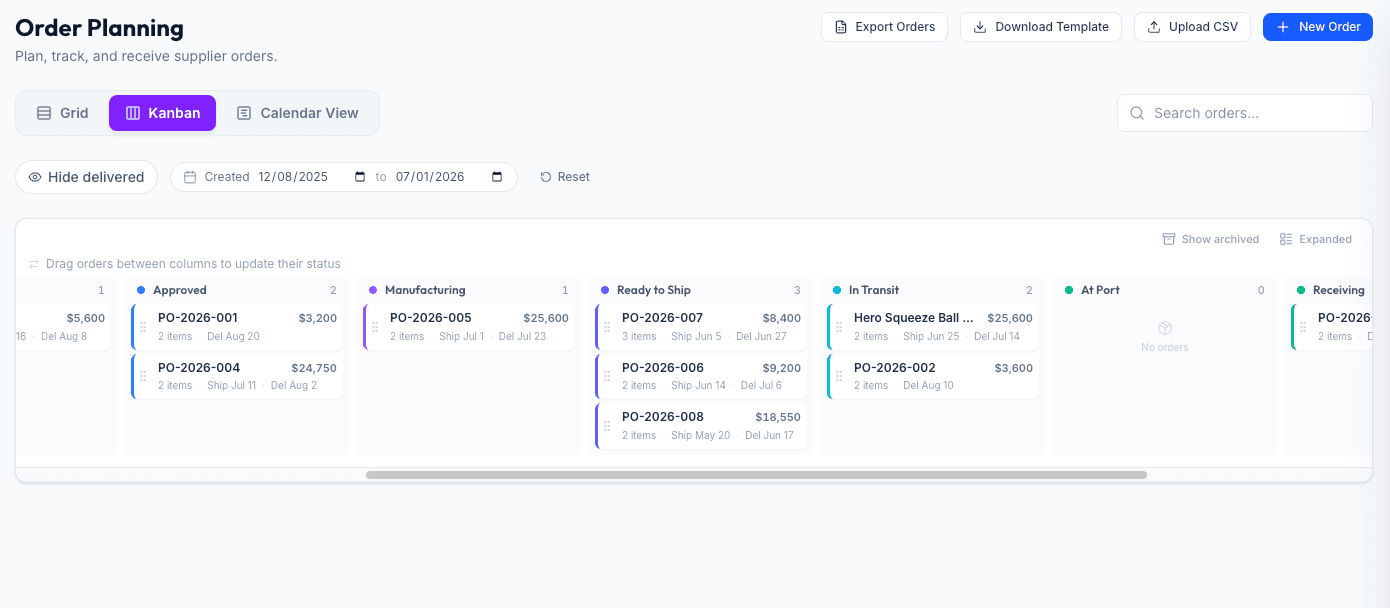
CBM tells you what the forwarder charges. Inventory Hero folds that freight into a real per-unit landed cost alongside duty and prep, ties it to your reorder timing, and keeps it current as shipments and rates change, so you order the right quantity at a cost you can trust.
- Freight folded into per-unit landed cost automatically
- Shipment planning tied to your reorder points
- Costs that update as rates and volumes move
No credit card required.
How the math works
- Carton CBM = L x W x H / 1,000,000 (centimeters)
- Total CBM = carton CBM x number of cartons
- Cubic feet = CBM x 35.3147
- Density = total weight (kg) / total CBM
Container internal volumes used here: 20ft = 1,172 cu ft (33 CBM), 40ft = 2,389 cu ft (68 CBM), 40ft high cube = 2,694 cu ft (76 CBM). Real loading reaches about 85% of those, so the fill bar is a planning guide, not a promise of a perfect stack.
Worked example
Your supplier's packing list says each carton is 60 x 45 x 40 cm and weighs 18 kg, and you are shipping 100 cartons.
- Per carton: 60 x 45 x 40 = 108,000 cubic centimeters, so 0.108 CBM per carton
- Total volume: 0.108 x 100 = 10.8 CBM, which is about 381.4 cu ft
- Weight: 100 x 18 = 1,800 kg (about 3,968 lb)
- Density: 1,800 / 10.8 = about 167 kg per CBM, well under the 1,000 mark where sea LCL starts billing by weight
- Container: about 32.5% of a 20ft container, so this ships LCL
At 10.8 CBM this is well under the ~15 CBM LCL break-even, so book LCL. Want to start from a unit count instead of a carton count? The freight and container calculator turns total units into cartons first, then rolls up the same volume. Shipping by air or courier, or want to confirm which side of the W/M rule you land on? Check the chargeable weight calculator. Then feed the freight quote into the landed cost calculator to get your true per-unit cost with duty and prep.
Key terms
- CBM (cubic meter)
- The volume unit ocean and air freight quote on. One CBM is about 35.3 cubic feet. To get it, multiply carton length by width by height in centimeters and divide by 1,000,000, then multiply by the carton count.
- W/M (weight or measurement)
- Why the density figure above matters: on sea LCL your CBM only stays the billing unit while the shipment is lighter than 1,000 kg per CBM. Denser than that and the forwarder switches to billing your weight in tons instead. The chargeable weight calculator works the full rule for air, courier, and sea.
- LCL (less-than-container-load)
- Sharing a container with other shippers and paying only for the space you use, billed on CBM. It usually beats booking a full container below about 15 CBM.
Frequently asked questions
What is CBM?
CBM is cubic meters, the standard unit of volume for ocean and air freight. It is how much space your shipment takes up, and for most consumer goods it is the number that fills a container and drives the freight quote. One CBM is about 35.3 cubic feet. Forwarders price by whichever is greater, your volume in CBM or your weight, so knowing your CBM tells you what you are actually paying for.
How do I calculate CBM from carton dimensions?
Multiply one carton's length by width by height in centimeters, then divide by 1,000,000 to get the CBM of a single carton. Multiply that by your carton count for the shipment total. For example, a 60 x 45 x 40 cm carton is 108,000 cubic centimeters, which is 0.108 CBM. One hundred of those cartons is 10.8 CBM. The calculator above does this for you and adds the container fit.
How do I calculate CBM in inches?
Multiply length by width by height in inches to get cubic inches, divide by 1,728 to get cubic feet, then divide by 35.3147 to get CBM. It is easy to slip a conversion, so the simpler path is to use the unit toggle on the calculator above: switch it to inches and pounds and it converts your figures to CBM for you.
How many CBM fit in a 20ft or 40ft container?
A 20ft container holds about 1,172 cubic feet (33 CBM) of internal volume, a 40ft standard about 2,389 cubic feet (68 CBM), and a 40ft high cube about 2,694 cubic feet (76 CBM). Those are nominal internal volumes; in practice you load roughly 85% of that because of pallet gaps and how cartons stack, so plan headroom rather than counting on a perfect fill.
What is the difference between CBM and chargeable weight?
CBM measures volume alone. Chargeable weight is what a carrier actually bills, and it compares your volume against your weight and charges on whichever is larger. For sea LCL that comparison is the W/M rule: the forwarder bills the greater of your weight in metric tons or your volume in CBM (one revenue ton equals one CBM or 1,000 kg). Air and courier use a volumetric divisor instead. If your shipment is dense, weight can win. To see which one bills your shipment, use the chargeable weight calculator.
Does CBM include the carton or just the product?
Use the outer dimensions of the packed carton, not the product inside it. Freight is charged on the space the shipment occupies in the container, which is the master carton's outside length, width, and height including the box walls. Measure the carton as it ships, sealed and ready to load, and use that for every CBM figure.
Inventory Hero
Know what a shipment really costs per unit
Inventory Hero turns your freight, duty, and prep into a true per-unit landed cost, ties it to how much you should reorder and when, and keeps it current as rates move, so a cheap freight quote never hides an expensive unit.
30-day free trialNo credit card required.
Embed this calculator
Free to use on your own site or blog. Paste this snippet where you want the calculator to appear. It keeps a small credit link back to Inventory Hero.
<iframe src="https://www.inventoryhero.ai/embed/cbm-calculator?utm_source=embed&utm_medium=iframe" title="CBM Calculator by Inventory Hero" width="100%" height="720" style="border:1px solid #e5e5e5;border-radius:16px;max-width:680px" loading="lazy"></iframe>
<p style="font:13px/1.5 system-ui,sans-serif;text-align:center;margin:8px 0 0"><a href="https://www.inventoryhero.ai/tools/cbm-calculator">CBM Calculator</a> by Inventory Hero</p>See all our free Amazon FBA calculators.