Free FBA tool
Chargeable Weight Calculator
Your numbers
Billing mode
Every mode is computed from your numbers. Pick which verdict headlines the result.
Shipment pieces
Your supplier's spec sheet is usually in cm / kg. Switch to in / lb above if you have imperial dimensions.
Air chargeable weight
120.0 kg
Volumetric (120.0 kg) beats actual (96.0 kg), so you pay for the space.
Actual weight
96.0 kg
211.6 lb on the scale
Total volume
0.72 CBM
Length x width x height x pieces
Air volumetric
120.0 kg
Volume / 6,000 (IATA)
Courier volumetric
144.0 kg
Volume / 5,000 (DHL, FedEx, UPS)
Carriers bill the greater of your actual weight and the volume-derived weight. The highlighted bar is what your selected mode charges on.
Treat these figures as a floor: carriers round up (couriers often round each piece to the next 0.5 kg) and apply minimum charges. If your invoice implies a different divisor than 6,000 or 5,000, ask your forwarder which contract rate applies.
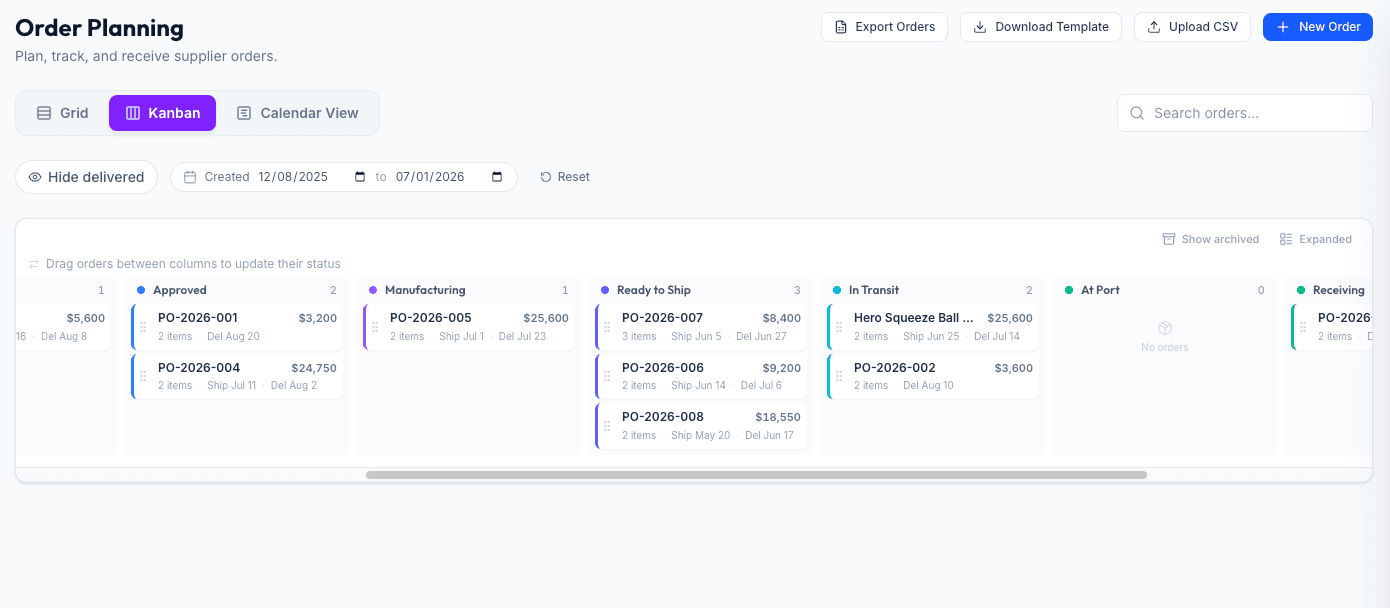
Get your true per-unit freight cost with Inventory HeroInventory Hero
From chargeable weight to true landed cost
Chargeable weight sets your freight bill, but freight is only one line of your real per-unit cost. Inventory Hero folds air, courier, or sea freight into a true landed cost alongside duty and prep, ties it to your reorder timing, and keeps it current as rates and shipment sizes change, so you pick the mode and quantity that actually pencil out.
- Air, courier, or sea freight folded into per-unit landed cost
- Mode and quantity tied to your reorder points
- Costs that update as rates and volumes move
No credit card required.
How the math works
- Air volumetric kg = L x W x H (cm) x pieces / 6,000 (IATA)
- Courier volumetric kg = L x W x H (cm) x pieces / 5,000 (DHL, FedEx, UPS)
- Chargeable weight = greater of actual weight and volumetric weight
- Sea LCL revenue tons = greater of weight in metric tons and CBM (W/M)
The 6,000 and 5,000 divisors are the published defaults for air and express courier; some forwarders negotiate different ones, so confirm yours. The sea weight-or-measurement rule breaks even at 1,000 kg per CBM: below that density volume bills, above it weight bills.
One thing this tool does not do: Amazon's own FBA dimensional weight. That is a separate rule (length x width x height in inches divided by 139) that feeds your fulfillment fee once units are in Amazon's network, not what a carrier bills to move the goods there. Size that with the FBA fee calculator and use this page only for the freight leg.
Worked example
You are shipping 12 cartons, each 50 x 40 x 30 cm and 8 kg. That is 96 kg on the scale and 0.72 CBM of volume.
- Actual weight: 12 x 8 = 96 kg; volume is 0.72 CBM
- Air: volumetric is 120 kg (720,000 cm3 / 6,000), which beats 96 kg, so air bills 120 kg
- Courier: volumetric is 144 kg (720,000 cm3 / 5,000), which beats 96 kg, so courier bills 144 kg
- Sea LCL: 0.72 CBM vs 0.096 t, so the measurement side wins and W/M bills 0.72 revenue tons
Every mode bills on volume here, because the cartons are light for their size. Feed the resulting freight cost into the landed cost calculator to get your true per-unit cost with duty and prep, and use the CBM calculator or the freight and container calculator to see how the same shipment fills a container.
Key terms
- Chargeable weight
- The weight a carrier bills you on: the greater of your actual scale weight and the volume-derived weight. This is the number you multiply by the per-kg rate.
- Volumetric (dimensional) weight
- A weight figure derived from a shipment's size rather than its mass, found by dividing the cubic volume by a carrier divisor (6,000 for air, 5,000 for express courier). It exists so carriers are paid for the space a light, bulky shipment takes up.
- W/M (weight or measurement)
- The sea LCL billing rule: revenue tons are the greater of your weight in metric tons and your volume in cubic meters. It breaks even at 1,000 kg per CBM.
Frequently asked questions
What is chargeable weight?
Chargeable weight is the figure a carrier actually bills you on: the greater of your shipment's actual (scale) weight and its volumetric weight, which is derived from its size. Light, bulky goods, which most private-label FBA products are, usually bill on volume, so a quote based on the scale weight alone reads low. This calculator shows both figures and the verdict for air, express courier, and sea. Treat the result as the floor of your bill: carriers also round up (couriers often round each piece to the next 0.5 kg) and apply minimum charges on top.
Why divide by 6,000 for air but 5,000 for courier?
The divisor converts cubic centimeters of space into kilograms of billable weight, and each network picked its own. Air freight uses the IATA standard of 6,000 cubic centimeters per kilogram. The express-courier networks (DHL, FedEx, UPS) use 5,000, a denser figure, so the same carton bills more volumetric weight by courier than by air. A smaller divisor means more chargeable kilograms for the same box. These are the published defaults; some forwarders negotiate other divisors on a contract, so confirm yours before you commit.
How do I lower my volumetric weight?
Volumetric weight is pure geometry, so shrink the box. Pack tighter and cut the air out of the carton: right-size the master carton to the product, reduce void fill, use flatter or nested packaging, and avoid oversized cartons with a lot of empty headspace. Because the divisor turns every cubic centimeter into billable weight, even trimming a couple of centimeters off each dimension can move you from billing on volume to billing on the scale. If your actual weight already exceeds the volumetric figure, tighter packing will not lower the bill, so weigh the tradeoff.
When does sea freight bill by weight instead of volume?
Sea LCL uses the weight-or-measurement (W/M) rule: it bills revenue tons, the greater of your weight in metric tons and your volume in cubic meters (CBM). The break-even is 1,000 kilograms per CBM. Below that density (the typical light consumer product) volume wins and you bill by CBM. Above it (dense goods like liquids, hardware, or anything heavy for its size) weight wins and you bill by the ton. So sea only bills by weight once your shipment is denser than a metric ton per cubic meter.
Is chargeable weight the same as Amazon's dimensional weight?
No, and mixing them up is a common and expensive mistake. Chargeable weight here is what your freight carrier bills to move the goods to Amazon. Amazon's own dimensional weight is a separate rule that feeds your FBA fulfillment fee once the product is in its network, and it uses a different formula: length x width x height in inches divided by 139. One is a freight cost, the other is a per-unit fulfillment fee. Size your fulfillment fee with the FBA fee calculator, and use this tool only for the freight leg.
What unit do freight forwarders quote air freight in?
Air freight is quoted per kilogram of chargeable weight, so the rate card you get is a price per kg multiplied by the chargeable weight, not your scale weight. That is exactly why the volumetric figure matters: a $4 per kg rate on a shipment that scales at 96 kg but charges at 120 kg volumetric costs you $480, not $384. Get the chargeable weight first, then apply the per-kg rate.
Inventory Hero
Know what a shipment really costs per unit
Inventory Hero turns your freight, duty, and prep into a true per-unit landed cost, ties it to how much you should reorder and when, and keeps it current as rates move, so a mode that looks cheap by the kilo never hides an expensive unit.
30-day free trialNo credit card required.
Embed this calculator
Free to use on your own site or blog. Paste this snippet where you want the calculator to appear. It keeps a small credit link back to Inventory Hero.
<iframe src="https://www.inventoryhero.ai/embed/chargeable-weight-calculator?utm_source=embed&utm_medium=iframe" title="Chargeable Weight Calculator by Inventory Hero" width="100%" height="720" style="border:1px solid #e5e5e5;border-radius:16px;max-width:680px" loading="lazy"></iframe>
<p style="font:13px/1.5 system-ui,sans-serif;text-align:center;margin:8px 0 0"><a href="https://www.inventoryhero.ai/tools/chargeable-weight-calculator">Chargeable Weight Calculator</a> by Inventory Hero</p>See all our free Amazon FBA calculators.