Free FBA tool
Container Check Digit Validator
Container number
Paste an ISO 6346 container number: 4 letters, then 6 digits, then 1 check digit. Spaces and hyphens are fine. Enter just the first 10 characters (4 letters + 6 digits) to compute the missing check digit.
Valid container number
Valid ISO 6346 number. The check digit (3) matches the formula.
This checks the ISO 6346 check-digit math only. It confirms the number is well formed, not that the container exists or its current status with the shipping line. If a valid number still will not track, look it up on the carrier's own site (the owner code above identifies the line via the BIC register) or ask your forwarder for the bill of lading tracking link instead.
Number breakdown
- Owner code
- CSQ
- Category
- U
- Serial
- 305438
- Check digit
- 3
Freight container
Inventory Hero
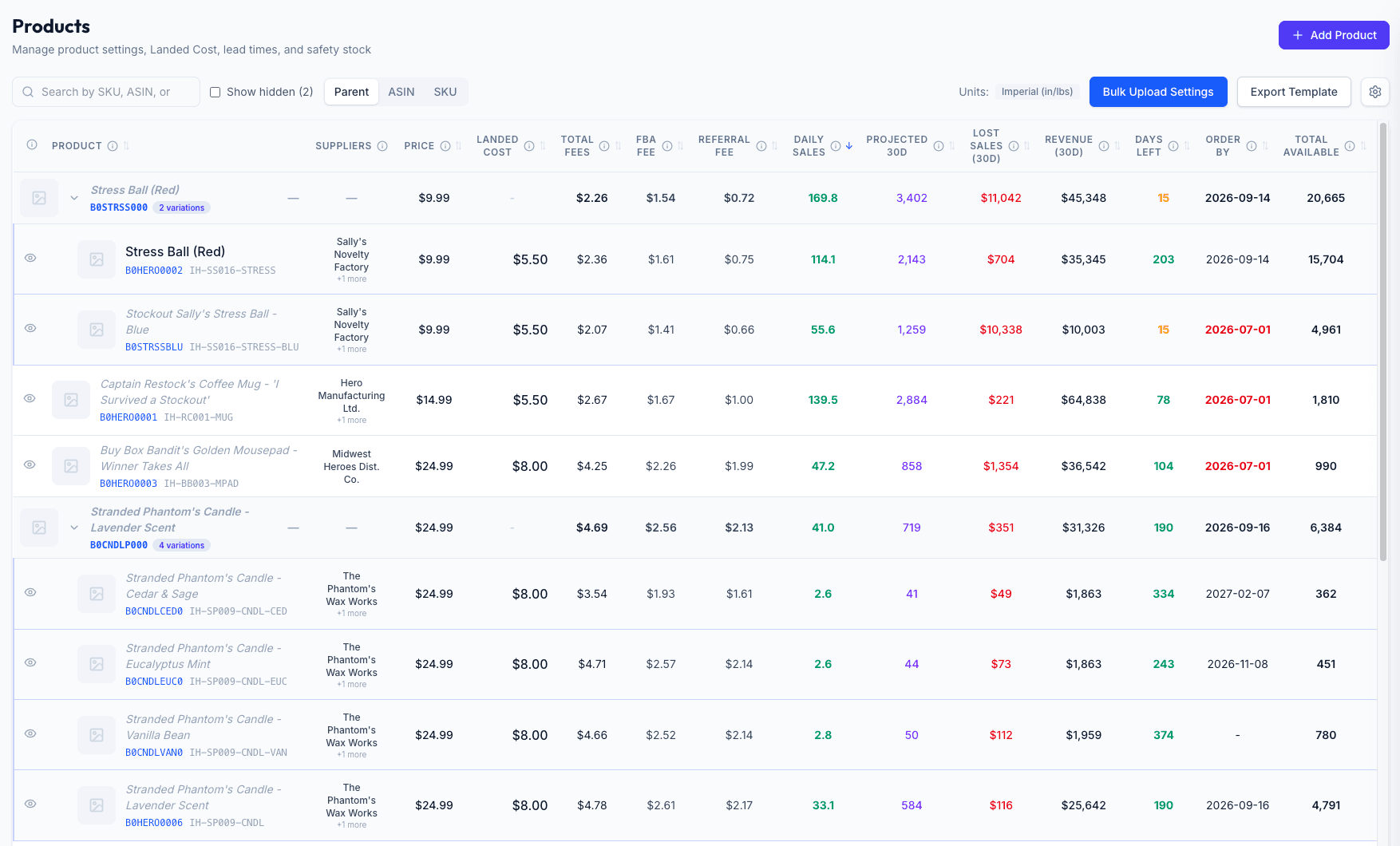
Track every PO and container into FBA
A valid container number is one line on a booking. Inventory Hero keeps the purchase orders and shipments behind it organized in one place, with the statuses and dates you and your team update, so a container number always ties back to which POs it carries and when that stock needs to become a restock.
- Purchase orders and inbound shipments in one view
- Landed cost and quantities tied to each SKU
- Restock timing that accounts for goods in transit
No credit card required.
How the check digit works
The ISO 6346 mod-11 formula
- 1. Map each character to a number. Digits map to themselves. Letters map A = 10, B = 12, C = 13, and so on, skipping every multiple of 11 (so there is no 11, 22, or 33).
- 2. Weight by position. Multiply each of the 10 characters by 2 raised to its position, from 2^0 on the left to 2^9.
- 3. Sum and take the remainder. Add the weighted values and divide by 11. The remainder is the check digit, and a remainder of 10 becomes check digit 0.
Worked example
Take CSQU3054383, the container number used as the specimen in ISO 6346 documentation. Drop the printed check digit and compute it from the first 10 characters, CSQU305438.
- Map the characters: C = 13, S = 30, Q = 28, U = 32, then the digits 3, 0, 5, 4, 3, 8.
- Weight by 2^0 to 2^9: 1, 2, 4, 8, 16, 32, 64, 128, 256, 512 across those values.
- Weighted sum: 13 + 60 + 112 + 256 + 48 + 0 + 320 + 512 + 768 + 4096 = 6185
- Check digit: 6185 mod 11 = 3, so the check digit is 3
- Full number: CSQU3054383, which is valid because the printed check digit is also 3
Change any single character and the remainder no longer lands on 3, so the number fails, which is exactly how the check digit catches a typo before it hits a booking. This mod-11 math is different from the GS1 mod-10 formula a product barcode uses, which the UPC and barcode validator checks. Once the container number checks out, size the load with the freight and container load calculator or work out shipment volume with the CBM calculator.
Key terms
- BIC code / owner prefix
- The first 3 letters of a container number, the owner code registered with BIC (the Bureau International des Containers). It identifies the container's owner or operator.
- Equipment category letter
- The 4th letter of the prefix. U is a freight container, J is detachable freight equipment, and Z is a trailer or chassis. Any other letter is not a standard BIC category.
- Check digit
- The final digit of the container number, derived from the other 10 characters by the ISO 6346 mod-11 formula. It exists to catch a mistyped or transposed character before the number is used.
Frequently asked questions
What is an ISO 6346 container number?
ISO 6346 is the international standard for marking shipping containers. Every container number is 11 characters: a 4-letter prefix, a 6-digit serial number, and 1 check digit. The prefix is a 3-letter owner code plus a 1-letter equipment category, so CSQU3054383 breaks down as owner CSQ, category U, serial 305438, and check digit 3. The check digit is computed from the other 10 characters, which is what lets a booking system catch a mistyped number.
What does the 4th letter in a container number mean?
The 4th letter is the equipment category. U means a freight container, the type you ship goods in and the overwhelmingly common case. J means detachable freight-related equipment that belongs to a container, and Z means a trailer or chassis. If the 4th character is anything else, it is not a standard BIC equipment category, so it is usually a sign the prefix was mistyped.
Why did my container number fail the check?
Almost always because a character was mistyped or two characters were transposed when the number was copied off a packing list, bill of lading, or email. The check digit exists to catch exactly that: it is math derived from the first 10 characters, so changing any single character makes the printed check digit no longer match. When a number fails here, re-read it against the source one character at a time, paying attention to the serial digits.
Can a container check digit be 0 in two different ways?
Yes. The formula takes the weighted sum modulo 11, and a remainder of 10 is written as 0, the same digit a remainder of 0 produces. That means two different serials can both end in check digit 0. BIC advises owners to skip serials whose remainder is 10 to avoid the ambiguity, but numbers that already use them are still valid under the standard and do exist, so this tool accepts them.
Who assigns container prefixes?
The 3-letter owner code is registered with BIC, the Bureau International des Containers, in Paris. BIC maintains the global register of owner prefixes, which is why a legitimate container number starts with a real registered prefix. This tool checks the check-digit math, not the register, so it confirms the number is well formed rather than looking up who owns it. To find the owner behind a prefix, search BIC's public register at bic-code.org, which is also the fastest way to work out whose tracking site to use.
Is this the same as a UPC check digit?
No. They are different algorithms for different codes. A UPC, EAN, or GTIN barcode uses the GS1 mod-10 formula, which weights digits by 3 and 1 from the right. A container number uses the ISO 6346 mod-11 formula, which maps letters to values and weights every character by a power of 2 from the left. If you meant to check a product barcode instead, use the UPC and barcode validator linked above.
Inventory Hero
From the container to the shelf
Inventory Hero tracks the purchase orders and shipments moving your inventory into FBA, so a validated container number is one clean link in a supply chain you can actually see.
30-day free trialNo credit card required.
Embed this calculator
Free to use on your own site or blog. Paste this snippet where you want the calculator to appear. It keeps a small credit link back to Inventory Hero.
<iframe src="https://www.inventoryhero.ai/embed/container-check-digit-validator?utm_source=embed&utm_medium=iframe" title="Container Check Digit Validator by Inventory Hero" width="100%" height="720" style="border:1px solid #e5e5e5;border-radius:16px;max-width:680px" loading="lazy"></iframe>
<p style="font:13px/1.5 system-ui,sans-serif;text-align:center;margin:8px 0 0"><a href="https://www.inventoryhero.ai/tools/container-check-digit-validator">Container Check Digit Validator</a> by Inventory Hero</p>See all our free Amazon FBA calculators.