Free FBA tool
FBA Profit Calculator
Your numbers
Net profit per unit
$11.00
You keep $11.00 per unit, a 36.7% margin and 122.2% return on cost.
After every cost you entered (add your ad cost above). Still excludes Amazon storage fees, VAT or sales tax, and returns.
Profit margin
36.7%
Profit / sale price
Return on cost
122.2%
Profit / cash in the unit
Amazon fees
$10.00
Referral + fulfillment
Break-even price
$17.06
$12.94 below your price
Inventory Hero
See true profit on every SKU, automatically
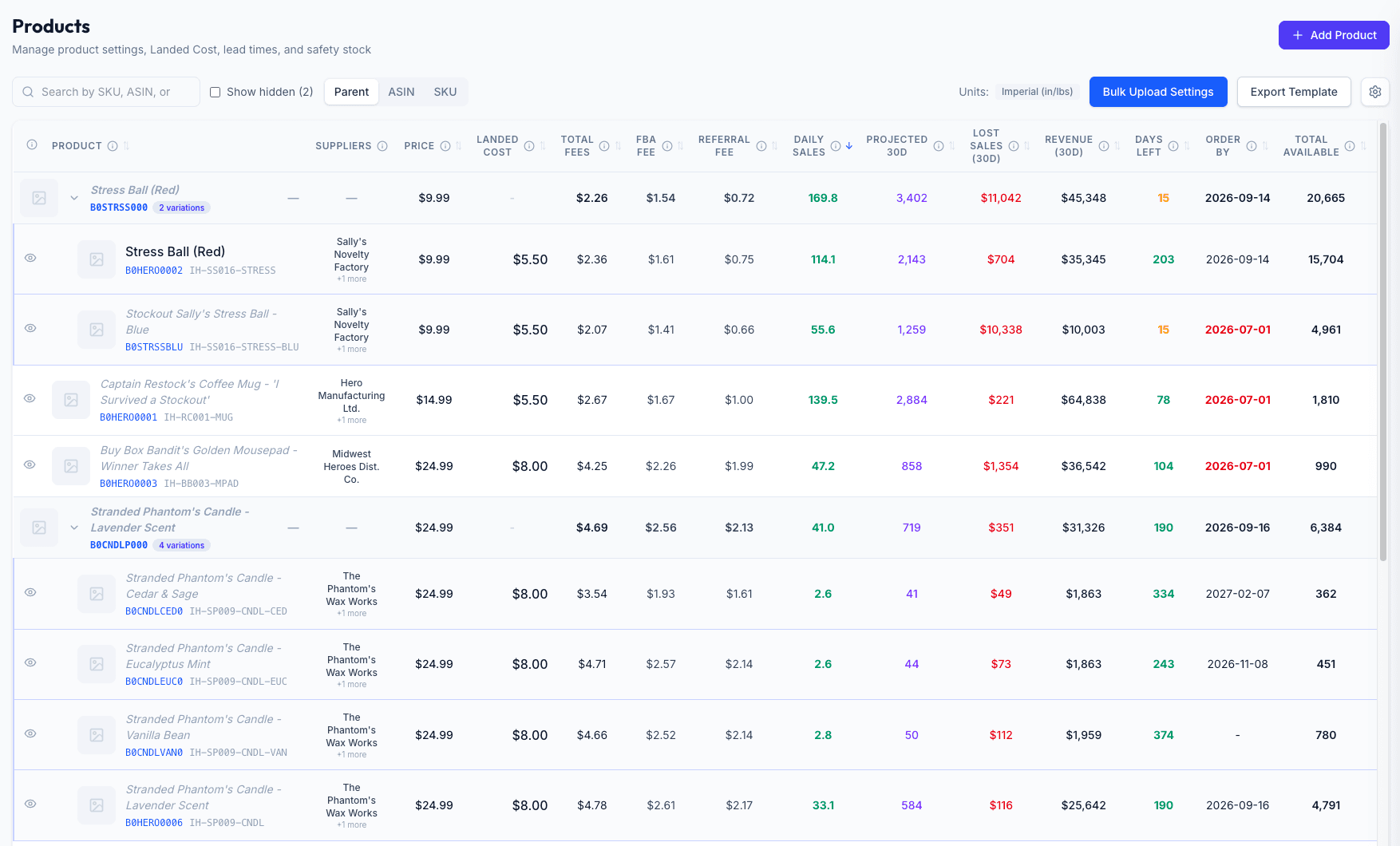
This calculator does one unit at one price. Inventory Hero pulls your Amazon fees and tracks landed cost per SKU, so you see real net profit and margin across your whole catalog as costs and prices move.
- Per-SKU profit and margin from your real costs and fees
- Landed cost that updates as freight and supplier prices change
- Spot thin-margin and money-losing SKUs before they drain cash
No credit card required.
How FBA profit is calculated
Net profit
Net profit = sale price − landed cost − referral fee − FBA fee − other cost
The referral fee is a percent of the sale price (15% in most categories). Margin is net profit divided by sale price; return on cost is net profit divided by the cash you put in the unit (landed cost plus other). Break-even price = (cost + FBA fee + other) / (1 − referral rate).
Worked example
A unit sells for $30. It costs $8 landed, the category referral fee is 15%, the FBA fulfillment fee is $5.50, and prep plus inbound shipping is $1.00 per unit.
- Referral fee: 15% of $30 = $4.50
- Amazon fees: $4.50 referral + $5.50 FBA = $10.00
- Net profit: $30 − $8 − $10 − $1 = $11.00 per unit
- Margin and ROI: 36.7% margin, 122.2% return on cost
- Break-even price: ($8 + $5.50 + $1) / 0.85 = $17.06
Once the unit profits, size each order with the EOQ calculator and time it with the restock calculator.
Key terms
- Referral fee
- Amazon's commission on each sale, charged as a percent of the sale price. Most categories are 15%, with a per-item minimum on low-price items.
- FBA fulfillment fee
- The flat per-unit fee Amazon charges to pick, pack, and ship the unit. It is set by the product's size tier and weight, not its price.
- Margin vs ROI
- Margin is profit as a percent of the sale price; return on cost is profit as a percent of the cash you put in the unit. A product can have a healthy margin but a weak ROI if it ties up a lot of capital.
Frequently asked questions
How do you calculate FBA profit per unit?
Start with your sale price, then subtract the landed cost of the unit, the Amazon referral fee (a percent of the sale price), the FBA fulfillment fee, and any other per-unit cost like prep or inbound shipping. What is left is your net profit per unit. This calculator does it live: for a $30 sale with $8 cost, a 15% referral, a $5.50 FBA fee, and $1 of prep, profit is $11.00.
What is a good profit margin for Amazon FBA?
Profit margin is net profit divided by sale price. Many private-label FBA sellers target a 15% to 30% net margin after all Amazon fees and product cost, before advertising. Thin margins below about 10% leave little room for ad spend, returns, and fee increases, so they are riskier even when the unit technically profits.
What ROI should I aim for, and how is it different from margin?
Return on cost (ROI) is net profit divided by the cash you put into the unit (landed cost plus prep), so it measures how hard your money works, while margin measures profit against the sale price. A common FBA rule of thumb is to look for 75% to 100%+ ROI on a new product so your capital recycles quickly. A high-margin, low-ROI product can still tie up a lot of cash.
Which fees does this calculator include?
The calculator includes the Amazon referral fee (a percent of sale price, 15% in most categories) and the FBA fulfillment fee (per-unit pick, pack, and ship), plus optional ad cost and other per-unit costs you enter. It does not include monthly or long-term storage fees, VAT or sales tax, or refund administration; those depend on velocity and strategy. Treat the result as the unit P&L before storage and overhead.
What is the break-even price?
The break-even price is the sale price at which net profit is exactly zero: your cost and fees are fully covered but you make nothing. Because the referral fee is a percent of price, it is your cost plus fulfillment plus other cost, divided by one minus the referral rate. Pricing below it loses money on every unit. For a $30 sale with $8 landed cost, a 15% referral, and a $5.50 FBA fee, break-even is $17.06.
Inventory Hero
Know your real profit on every SKU
This calculator does one unit at one price. Inventory Hero tracks landed cost, Amazon fees, and storage across every SKU, so you see true profit and margin per product as your costs and prices move.
30-day free trialNo credit card required.
Embed this calculator
Free to use on your own site or blog. Paste this snippet where you want the calculator to appear. It keeps a small credit link back to Inventory Hero.
<iframe src="https://www.inventoryhero.ai/embed/fba-profit-calculator?utm_source=embed&utm_medium=iframe" title="FBA Profit Calculator by Inventory Hero" width="100%" height="720" style="border:1px solid #e5e5e5;border-radius:16px;max-width:680px" loading="lazy"></iframe>
<p style="font:13px/1.5 system-ui,sans-serif;text-align:center;margin:8px 0 0"><a href="https://www.inventoryhero.ai/tools/fba-profit-calculator">FBA Profit Calculator</a> by Inventory Hero</p>See all our free Amazon FBA calculators.