How to Get Your Trump Tariff Refund: An Amazon Seller's Step-by-Step Guide to the IEEPA CAPE Process | Inventory Hero
·12 min readCash Flow
How to Get Your Trump Tariff Refund: An Amazon Seller's Step-by-Step Guide to the IEEPA CAPE Process
The Supreme Court struck down the IEEPA tariffs. CBP is now refunding them through the CAPE tool in ACE. Here is exactly who is eligible, who is not, and how I got $25,242 back (with interest), with the forms, links, and pitfalls in one place.
Andrew Erickson is the founder of Inventory Hero. He has spent years working with Amazon FBA sellers on demand forecasting, restock planning, and the cash flow side of running a private-label brand. Inventory Hero exists because every spreadsheet-based inventory system he tried eventually broke — usually right before Q4.
Pull a recent CBP Form 7501 from your customs broker. The Importer of Record number on line 22 must match your EIN. If a freight forwarder or your supplier is listed (common with DDP shipping terms), the refund will not come to you. Note that Amazon Global Logistics users are still the IOR: AGL only makes Amazon Customs and Trade your broker, not your IOR.
2
Pull your record of IEEPA duties paid
Ask your customs broker for a per-entry list of IEEPA duties paid between February 4, 2025 and February 24, 2026. If Amazon Customs and Trade was your broker, they emailed this list automatically in April 2026 (entries starting with INL).
3
Apply for an ACE Portal Top Account
Go to ace-accounts.cbp.gov/s/importer-form. You will need your Importer Record Number (IR# / EIN), legal company name, and the business email on your CBP 5106 record. Complete the captcha and submit. CBP emails a verification code within 10 minutes.
4
Create your ACE login and complete two-factor
After CBP creates the account, you receive a separate email from noreplyace@cbp.dhs.gov. You have 72 hours to follow the link, set a password at ace.cbp.gov, and complete two-factor authentication. Use Edge or Chrome and clear your cache first.
5
Add your US bank account for ACH refunds
Inside ACE go to Accounts then Importer, click your company, open the ACH Refund Authorization tab, click Add ACH Info, and submit your US bank routing and account number. CBP cannot refund to a foreign bank. If you do not have a US account, open one with Mercury, Wise, Payoneer, or Airwallex first.
6
Submit your CAPE claim or have your broker submit it
Log into ACE, open CAPE, and upload a CSV of the entry summary numbers you want refunded. The system removes the IEEPA HTS lines, reliquidates the entry, and sends the refund by ACH. If Amazon ACT was your broker, you can authorize them to submit on your behalf via their Pulse survey link in the duties-paid email.
Frequently Asked Questions
Who is eligible for the IEEPA Trump tariff refund?
Only the Importer of Record (IOR) listed on the CBP Form 7501 for each entry can claim the refund. The entry must be either unliquidated, or within 80 days past liquidation, to qualify for Phase 1. The duty must have been an IEEPA-coded duty paid between February 4, 2025 and February 24, 2026 (the fentanyl, reciprocal, Venezuela, Brazil, and Russia tariffs). Section 232 steel and aluminum duties and Section 301 China duties are not refundable, those are separate statutes that the Supreme Court did not touch.
Who is NOT eligible, even though they paid the tariff in their landed cost?
Two groups commonly miss out. First, sellers who shipped DDP (Delivered Duty Paid) where the supplier or freight forwarder was the Importer of Record. The refund goes to whoever is on line 22 of the 7501, and with DDP that is usually not you. Second, anyone whose shipments cleared under Section 321 de minimis (under 800 dollars per shipment), which did not collect IEEPA duties in the first place and so has nothing to refund. Importantly, Amazon Global Logistics (AGL) users ARE eligible: AGL only makes Amazon Customs and Trade your broker, not your IOR. Your EIN is still on the 7501, the refund is still yours. You may have a contractual claim against your supplier or 3PL to pass a DDP refund through, but CBP will only send the money to the IOR.
What is IEEPA and why were the tariffs struck down?
IEEPA is the International Emergency Economic Powers Act, a 1977 statute that lets the President regulate international commerce during a declared national emergency. In 2025 the Trump administration used IEEPA to impose the fentanyl tariffs (February 4, 2025) and the reciprocal tariffs (April 5, 2025) on imports from many countries. On February 20, 2026 the Supreme Court ruled 6-3 in Learning Resources v. Trump that IEEPA does not grant the power to impose tariffs, because the power to tax belongs to Congress under Article I. The Court of International Trade then ordered CBP to refund the duties for all non-final and recently-liquidated entries on March 4, 2026, and extended that order to already-liquidated entries on March 27, 2026.
Which HTS codes were used for the IEEPA tariffs, and how do I check if I paid them?
The IEEPA tariffs were assessed under two ranges of Harmonized Tariff Schedule codes. HTS 9903.01.xx covers the reciprocal tariffs (April 5, 2025 onward), and HTS 9903.02.xx covers the fentanyl / trafficking tariffs (February 4, 2025 onward), including the Canada, Mexico, and China actions. To check if you paid them, pull any CBP Form 7501 from 2025 and scan the line items for one of those code ranges. If you see them, that line item is the IEEPA duty and that dollar amount is what you should expect back as a refund (plus statutory interest). If neither code appears on any of your 7501s, you did not pay IEEPA duties and the refund does not apply. This is the fastest eligibility check available; you do not need a broker spreadsheet or an ACE login to do it.
How do I know if my entry has been liquidated or not?
Three ways. (1) Ask your customs broker: they can pull entry-by-entry status from ACE in five minutes. If Amazon Customs and Trade is your broker, the duties-paid email they sent in April 2026 already includes a Liquidation Date column and a Phase 1 eligibility flag. (2) Log into the ACE Portal, go to Reports, and run the Entry Summary Status Report (ESM-001) for your importer record. Each entry shows as Unliquidated, Liquidated, or Cancelled. (3) The CBP Form 7501 alone is not enough: it shows the entry date but liquidation happens later, usually 314 days after entry but extendable up to four years. For the refund, what matters is whether the entry is unliquidated or within 80 days past its liquidation date, and both qualify for Phase 1.
What is CAPE and how is Phase 1 different from Phase 2?
CAPE stands for Consolidated Administration and Processing of Entries. It is the CBP tool inside the ACE Portal that processes IEEPA refund requests in bulk rather than one entry at a time. Phase 1, live since April 20, 2026, covers entries that are either still unliquidated or are within 80 days past their liquidation date. Phase 2 will cover already-finalized older entries and is not live yet. If your entry is past 80 days from liquidation and you want to preserve a claim, file a protest under 19 USC 1514 within 180 days of liquidation rather than waiting for Phase 2 to open.
Do I need a US bank account to get the refund?
Yes. Under the Electronic Refunds Final Rule (FR Document 2025-24171) and 31 USC 3332, CBP can only refund tariffs by ACH to an account at a bank with a US branch. Paper checks and foreign bank wires are not options. Sellers based outside the US commonly open an account at Mercury, Wise, Airwallex, or Payoneer for this purpose. None of these are affiliated with CBP or Amazon. The ACE Portal also requires that this US account be added in the ACH Refund Authorization tab of your importer record before any refund can be sent.
How long does the IEEPA refund actually take, and does it include interest?
For us, the elapsed time was about 30 days from CAPE submission to the ACH deposit hitting our US account, on entries that were already past liquidation. The ACE Portal and ACH setup took another two to three weeks on the front end, mostly waiting on CBP verification emails. Plan for six to eight weeks end to end if you are setting up ACE for the first time. Yes, the refund includes statutory interest under 19 USC 1505 calculated from the date the duties were originally deposited. For our 4 entries the interest came to roughly 5.8 percent of the duty refund (about $1,382 on top of $23,860). The deposit arrives as a single ACH from CBP TREAS 310 covering principal plus interest.
Do I have to give the refund to my customers?
No, there is no federal requirement to pass an IEEPA refund through to downstream customers. The refund is owed to the Importer of Record because the IOR is the entity that paid the duty to CBP. Whether you pass it through depends on your contracts. If you priced the tariff as a separate line item or a tariff surcharge, your customer probably has a contractual expectation of a refund. If you absorbed it into landed cost and held your retail price, the refund is windfall margin that you are free to redeploy into inventory, ad spend, or cash reserves.
Does this affect any tariffs that are still in place?
Yes, but read the categories carefully. The IEEPA fentanyl tariffs, reciprocal tariffs, Venezuela tariffs, Brazil tariffs, and Russia tariffs are vacated and refundable. Section 232 tariffs (steel, aluminum, autos) are still in force, those are based on the Trade Expansion Act of 1962. Section 301 tariffs (the original China tariffs from 2018 onward) are also still in force, those are based on the Trade Act of 1974. The administration has signaled new tariff actions under those authorities to replace some IEEPA revenue, so do not assume your future landed cost is going down by the full IEEPA amount.
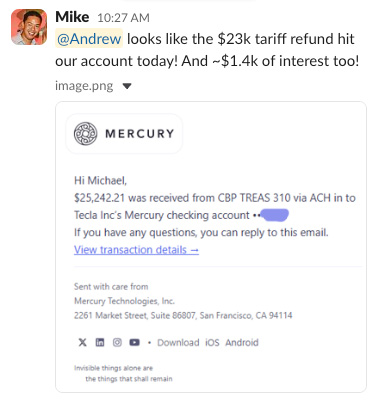
My business partner DM'd me this morning:
Mike, 10:27 AM
@Andrew — looks like the $23k tariff refund hit our account today! And ~$1.4k of interest too!
My response:
Andrew, 10:27 AM
fuck yea!!
The screenshot underneath the message was a Mercury Bank notification: "$25,242.21 was received from CBP TREAS 310 via ACH into your Mercury checking account."
The DM that prompted this article.
Three months earlier the Supreme Court had ruled the Trump IEEPA tariffs unconstitutional. Now CBP was actually paying the money back, with interest, and most Amazon sellers I know either have no idea the refund exists, assume Amazon will handle it, or have been told they are not eligible without checking why.
This article is the playbook I wish someone had handed me on day one. It explains what happened, who qualifies, who does not (this part matters more than the qualification list), and the exact 6-step process to claim your refund through the CAPE tool in ACE.
The colloquial name for refunds of duties collected under the International Emergency Economic Powers Act (IEEPA) between February 4, 2025 and February 24, 2026. The Supreme Court ruled the underlying tariffs unconstitutional on February 20, 2026 (Learning Resources v. Trump), and CBP is now refunding them through the Consolidated Administration and Processing of Entries (CAPE) tool in the ACE Portal.
The IEEPA tariffs are the ones the public knew as the reciprocal tariffs (April 5, 2025) and the fentanyl tariffs (February 4, 2025), plus smaller country-specific actions against Venezuela, Brazil, and Russia. They are different from the Section 232 steel and aluminum tariffs and from the Section 301 China tariffs, both of which are still in effect because the Supreme Court ruling did not touch those statutes.
CBP collected roughly $133.5 billion under IEEPA before the ruling. Wharton's Penn Budget Model projects the eventual refund pool at up to $175 billion once interest and pending entries are included.
In Learning Resources, Inc. v. Trump (No. 24-1287), decided February 20, 2026, the Supreme Court held 6-3 that the International Emergency Economic Powers Act does not authorize the President to impose tariffs of indefinite scope. The reasoning, in plain terms: tariffs are taxes, the power to tax belongs to Congress under Article I of the Constitution, and IEEPA's emergency-powers language does not contain the kind of clear delegation that would let the executive branch impose new taxes unilaterally.
The decision invalidated:
The reciprocal tariffs announced April 2, 2025 and effective April 5, 2025 (the broad country-by-country tariffs that hit most US imports)
The fentanyl / trafficking tariffs effective February 4, 2025 (additional duties on Canada, Mexico, and China linked to fentanyl trafficking)
The smaller IEEPA actions against Venezuela, Brazil, and Russia
Two weeks later, on March 4, 2026, the Court of International Trade ordered CBP to liquidate or reliquidate all non-final entries without regard to IEEPA duties. On March 27, 2026, Judge Eaton amended that order to cover already-finalized entries as well, which is why some sellers can now reach back to entries from early 2025.
This is the question that decides whether you read the rest of this article or close the tab. The refund goes to the Importer of Record (IOR) listed on line 22 of the CBP Form 7501 for each entry. Nobody else.
Use this checklist before you do anything else:
The DDP trap is the one that costs sellers the most money. If your Chinese supplier quoted you a price that "included duties to your warehouse," that is DDP shipping, and they were almost certainly the IOR. Which party ends up as the importer of record is set by the Incoterm on your purchase order, so this was decided long before the refund ever existed. CBP will refund that money to them, not to you. You may have a contractual basis to ask for it back, but it is a private commercial conversation, not a CBP claim.
A common point of confusion: Amazon Global Logistics (AGL) users are eligible. This is how we got our refund. When you ship through AGL, Amazon Customs and Trade acts as your customs broker (entries get the INL prefix), but you remain the Importer of Record on the 7501: your EIN, your refund. The "broker" and the "IOR" are different roles. AGL just runs the paperwork on your behalf. ACT actually makes the refund process easier by emailing you a pre-built CSV of your IEEPA duties and offering to file the CAPE claim for you.
This is the one piece of customs jargon you cannot skip, because Phase 1 eligibility hinges on it.
Liquidation (customs)
The final, official calculation by CBP of all duties, taxes, and fees owed on an import entry. When you first import goods you pay an estimated duty amount; CBP later reviews the entry and either confirms it (liquidates) or adjusts it. Once liquidated, the entry is "finalized" for customs purposes. The default liquidation timeline is 314 days after the entry date, though it can be extended up to four years.
Two statuses matter for the refund:
Unliquidated. CBP has accepted your entry but has not finalized the duty calculation yet. Most entries from late 2025 and early 2026 are still in this state. Eligible for CAPE Phase 1.
Liquidated. CBP has finalized the entry. If liquidation happened within the last 80 days, the entry is still eligible for Phase 1. If it happened more than 80 days ago, you are out of Phase 1 and waiting on Phase 2 (or you need to file a protest under 19 USC 1514, which has a 180-day window from the liquidation date).
Ask your customs broker. Easiest. They can pull entry-by-entry status from ACE in five minutes and email you a spreadsheet. If Amazon Customs and Trade is your broker, the duties-paid email they sent in April 2026 already includes a Liquidation Date column and a flag for Phase 1 eligibility.
Look it up yourself in the ACE Portal. Once you are logged into ACE, go to Reports and run the Entry Summary Status Report (ESM-001) for your importer record. The status column will read Unliquidated, Liquidated, or Cancelled for each entry.
Read the CBP Form 7501. The 7501 itself shows the entry date but not the liquidation date, because liquidation happens later, after the form was filed. Use it to confirm your EIN is the IOR, then use ACE or your broker for the liquidation status.
The 80-day clock starts on the liquidation date, not the entry date. An entry from January 2025 that liquidated in March 2026 is well within the Phase 1 window. An entry from March 2025 that liquidated in November 2025 is already past 80 days and needs Phase 2 or a protest.
This is the process that worked for us. Total elapsed time from "let me look at this email" to "ACH deposit hit the account" was about 30 days, because we already had a US bank account ready. Add 2 to 3 weeks if you are starting from zero. The full step-by-step is rendered automatically in the How To section below the article; here are the practical notes from actually running it.
Use the right browser. The ACE Portal is finicky on Safari and most mobile browsers. Use desktop Edge or Chrome with cache cleared.
The captcha needs a US IP. Some non-US users reported that the image captcha would not render. A US-based VPN exit node fixed it.
Routing number must be 9 digits, account number up to 17. ACE will reject Wise account numbers that include letters. Double-check the format with your bank before submitting.
If Amazon was your broker, the easy path exists. Entries starting with the prefix INL were brokered by Amazon Customs and Trade. The email Amazon sent in April 2026 contains a Pulse survey link where you can authorize them to file CAPE on your behalf. You still need the ACE account and ACH set up to receive the money, but ACT handles the filing. For us this cut the work significantly on 4 entries.
Phase 2 is the unknown. CBP has not published a timeline for Phase 2 (already-finalized older entries). If you have entries past 80 days from liquidation and the math is material, file a protest under 19 USC 1514 within 180 days of liquidation rather than waiting. A protest preserves your refund right; sitting on it does not.
The IEEPA refund is the largest one-time cash-flow event most Amazon private-label brands will see this decade. To put it in scale: if you imported $500,000 of goods from China in 2025 at an average 25% IEEPA-coded duty rate, you are sitting on roughly $125,000 in refundable cash. That is enough to fund an entire Q4 reorder, an ad budget for a product launch, or just a real cash cushion against the next supply-chain surprise.
A few things to think about as the refund hits your account:
It is not income, it is a refund of cost. Talk to your CPA, but for most sellers it reduces COGS in the year it relates to, not in the year it arrives.
Do not use it to fund inventory at the old, tariff-inflated landed cost. Your forward landed cost is lower now. Reorder math should use the new number, not the old one.
If you have been over-stocked because of pre-tariff defensive buying, this is the cash to absorb storage fees while you sell through and shorten your cash conversion cycle.
This is exactly the kind of decision where having a real handle on your numbers matters more than the refund itself. We built InventoryHero because the spreadsheet most sellers use to track sales velocity, days of cover, reorder points, and cash deployment falls apart the moment something asymmetric happens: a stockout, a tariff change, a refund landing in the account. If you want help turning the refund into smarter restock decisions instead of just another transfer to the operating account, the InventoryHero fee calculator is a good starting place to model what your unit economics look like at the new, post-IEEPA landed cost. The landed cost calculator rebuilds your per-unit cost without the vacated duty, so your next reorder runs on the real number instead of the tariff-inflated one.
The CAPE Phase 1 window is not infinite. Two things can shorten it for any individual seller: (1) your entries cross the 80-days-past-liquidation threshold and fall out of Phase 1, and (2) the administration has signaled it will appeal pieces of the CIT order and may use other tariff authorities (Section 232, Section 122) to recover revenue. Neither of those undoes refunds already paid, but they argue strongly for filing now rather than waiting to see what happens.
Get the ACE account opened this week. Get the ACH account loaded next week. File the CAPE claim, or authorize your broker to file it, the week after. The money is yours, but only if you go get it.